

Researchers Develop Configurational Entropy Engineering Strategy for Ultrabroadband Emission from Bi-Doped Glass Fiber
Recently, a team led by Prof. Lili Hu at the Shanghai Institute of Optics and Fine Mechanics (SIOM), Chinese Academy of Sciences, developed a configurational entropy engineering strategy for Bi-doped glass and fiber.
By controlling glass-formation kinetics, the researchers trapped the glass network in a high-energy, highly disordered configurational state. This state effectively suppressed Ge/Bi aggregation and the resulting nonradiative energy dissipation. Using this approach, they fabricated a Bi-doped silica fiber (BDF) with markedly lower background and unsaturable losses. The fiber enabled broadband amplification from 1680 to 1750 nm, laser operation at 1650 and 1720 nm, and proof-of-concept methane sensing. The study, entitled “Configurational Entropy Engineering of Bi-Doped Glass Fiber Enabling Ultrabroadband Emission,” was published in Advanced Functional Materials on July 10, 2026.
Near-infrared (NIR) broadband amplifiers and lasers are vital light sources for next-generation high-capacity optical communications, molecular spectroscopy, and fiber-optic sensing. However, the effective gain window of conventional erbium-doped fiber amplifiers (EDFAs) is relatively narrow and cannot independently meet the growing demand for transmission bandwidth. The BDFs can produce broadband NIR emission across 1000–1800 nm and are compatible with matured silica-fiber fabrication technologies. They are therefore considered promising candidates for extending optical communication bands.
The main challenge of BDF is the trade-off between gain and loss. The optical properties of bismuth active centers (BACs) are highly sensitive to their local coordination environments. Increasing the Bi content can enhance gain, but excess Bi ions tend to aggregate within Ge-rich regions. This aggregation produces non-emissive atomic clusters and quenching centers, thereby increasing background loss and unsaturable loss (UL). Suppressing elemental aggregation while maintaining a high dopant concentration is therefore essential for high-performance Bi-doped fiber devices. Unlike high-entropy alloys, which derive their entropy from multicomponent mixing, this new strategy treats the glass-formation pathway itself as a design variable. Hyper-quenching freezes the disordered topology of the high-temperature melt into a high-energy, high-configurational-entropy metastable state.
In Ge/Bi co-doped silica, the Si–O network freezes first, while the still-mobile Ge–O units tend to form Ge-rich domains. Bi ions preferentially partition into these domains. Conventional cooling leaves sufficient time for Ge migration and Bi aggregation, producing enlarged Ge- and Bi-rich domains. By contrast, hyper-quenching imposes kinetic arrest before the domains can grow.
Spherical aberration-corrected transmission electron microscopy (AC-TEM) showed that the average Ge-rich domain size fell from 5.42 nm under slow cooling to 1.66 nm after quenching. Synchrotron X-ray total scattering and pair distribution function (PDF) and relative pair distribution function (rPDF) analyses revealed stronger Bi-related pair peaks and medium-range oscillations in the slowly cooled sample. These observations indicate more extensive Ge/Bi aggregation.
Using identical preforms, the team increased only the fiber-drawing speed, from 30 to 100 m/min, to subject the fiber core to stronger hyper-quenching. With essentially unchanged Ge and Bi contents, background loss fell from 400 to 210 dB/km. Meanwhile, UL decreased from 33.5% to 25.8%.
The resulting fiber delivered more than 20 dB net gain across 1680–1750 nm. Its average net gain was about 5 dB higher than that of the reference fiber. Laser output was achieved at both 1720 and 1650 nm. When the 1650 nm laser was coupled to a hollow-core fiber gas cell, its output power decreased systematically with increasing methane pressure.
This result provides a proof-of-concept demonstration of gas sensing. The significance of this work lies in its extensions to rare-earth-doped glasses, amorphous luminescent materials, and other functional glass systems. Combined with multiscale simulations, in situ characterization, and advanced forming processes, it could also establish quantitative relationships among formation pathways, local structures, and device performance.
Collaborators from Nanjing University of Posts and Telecommunications, Kyoto University, and other affiliated institutions have also made substantial contributions to this work.
Article website: https://advanced.onlinelibrary.wiley.com/doi/10.1002/adfm.77026
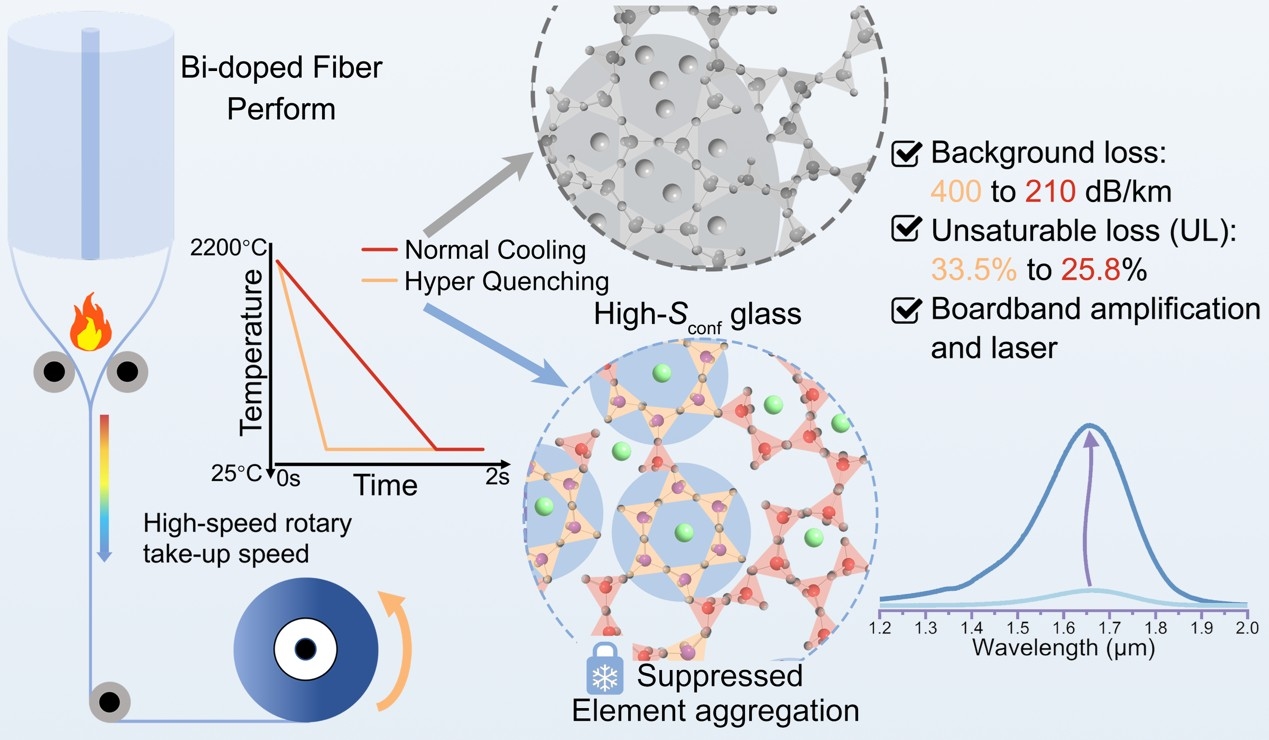
Figure 1 Graphical Abstract. High-speed fiber drawing drives the fiber formation process into the ultrafast quenching regime, freezing a high-configurational-entropy glass structure, suppressing Ge/Bi clustering, reducing background and non-saturable losses, and enabling broadband amplification and laser output.
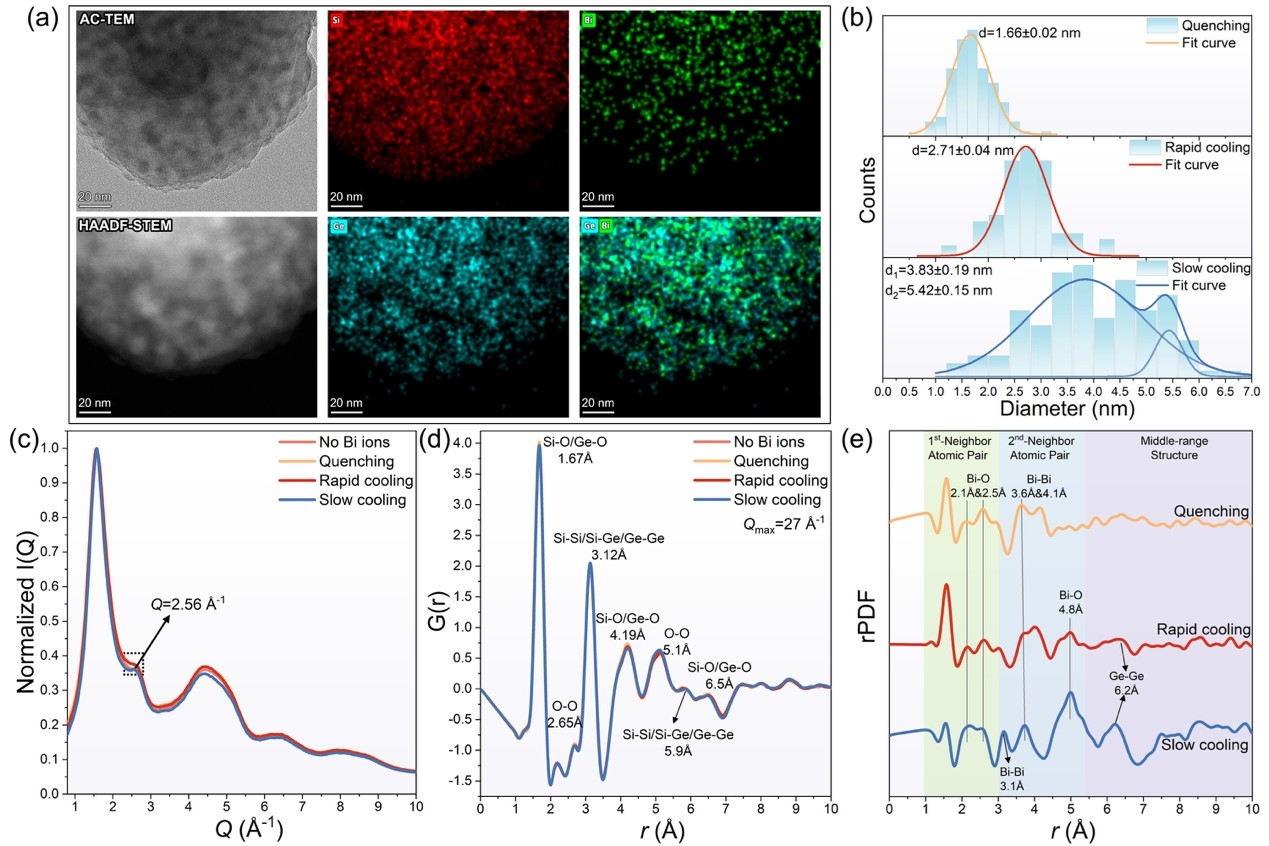
Figure 2. Multiscale structural evidence. Spherical aberration-corrected TEM elemental mapping, synchrotron X-ray total scattering, and rPDF analysis jointly demonstrate the effects of rapid quenching. The results show smaller Ge-rich domains and suppressed aggregation of Bi-related structures.
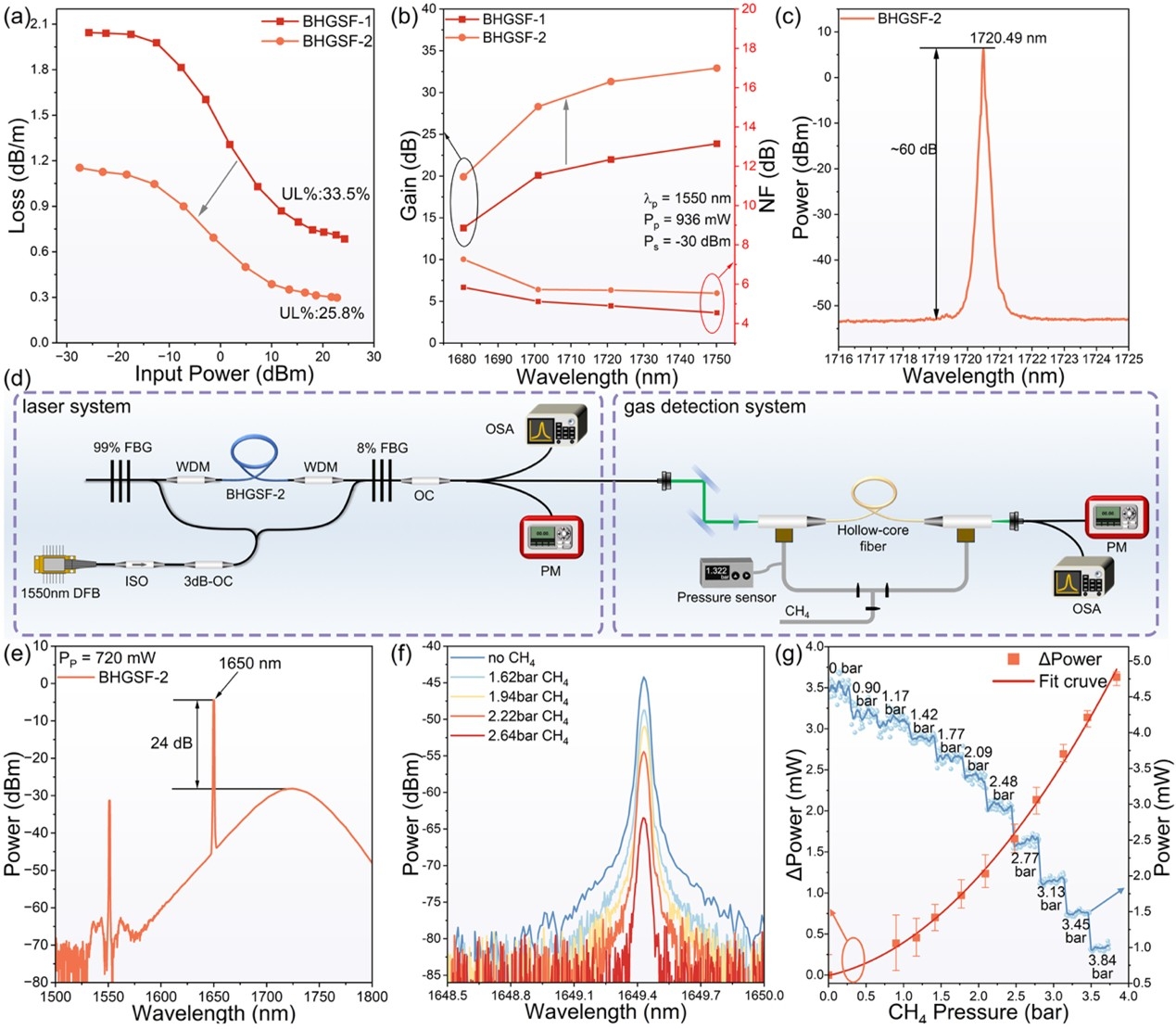
Figure 3. Device-level performance validation. The entropy-engineered fiber delivers lower UL, broadband amplification across 1680–1750 nm, and laser output at 1650 and 1720 nm. It also enables methane sensing using a hollow-core fiber gas cell.