

New Progress in Understanding the Suppression Mechanism of Phase Separation in Mixed-Network Former Glasses
Recently, the Department of Advanced Laser and Optoelectronic Functional Materials at the Shanghai Institute of Optics and Fine Mechanics (SIOM), Chinese Academy of Sciences, revealed, on the atomic scale, how Al2O3 inhibits phase separation in NaPO3–SiO2 glasses, providing an important theoretical basis for designing functional glasses with high homogeneity and stability. The related results were published in The Journal of Physical Chemistry C under the title “Composition-Structure Correlations in Al2O3–NaPO3–SiO2 Mixed-Network Former Glasses: Insights from Advanced Solid-State NMR Spectroscopy”.
Phosphate-silicate mixed-network former glasses combine the low melting and high dopant capacity of phosphate glasses with the favorable thermal and chemical stability of silicate glasses, offering greater freedom for co-designing structure and properties. However, because different network formers differ in their local structures and bonding modes, phosphate-silicate glasses still suffer from insufficient resistance to hydrolysis, a tendency to phase separation, relatively poor thermal stability, and weak mechanical properties. Therefore, studying the microscopic structural rules of mixed-former glasses and revealing the intrinsic causes of their phase separation is important for the development of such functional glasses.
Using a suite of advanced solid-state NMR (SSNMR) techniques, this study elucidated how composition affects phase separation behavior in mixed-network former glasses. It was found that in the 80NaPO3–20SiO2 glass the network is dominated by homonuclear linkages such as Si–O–Si and P–O–P, with Na+ ions mainly concentrated in the phosphate phase, and significant phase separation present. With the addition of Al2O3, Al preferentially bonds with phosphate units to form Al–O–P linkages; when the average number of Al atoms bonded per P atom exceeds two, Al–O–Si linkages begin to increase markedly. This structural evolution drives part of the Na+ population to migrate from phosphate-rich regions into the silicate network and gradually form Si–O–Al–O–P connections, which effectively suppresses phase separation between different network formers and leads to a highly homogenized glass structure. The study thus clarifies the atomic-scale structural mechanism by which Al2O3 inhibits phase separation in mixed-network former glasses.
This work was supported by the Strategic Priority Research Program of the Chinese Academy of Sciences [Grant No. XDB0650000].
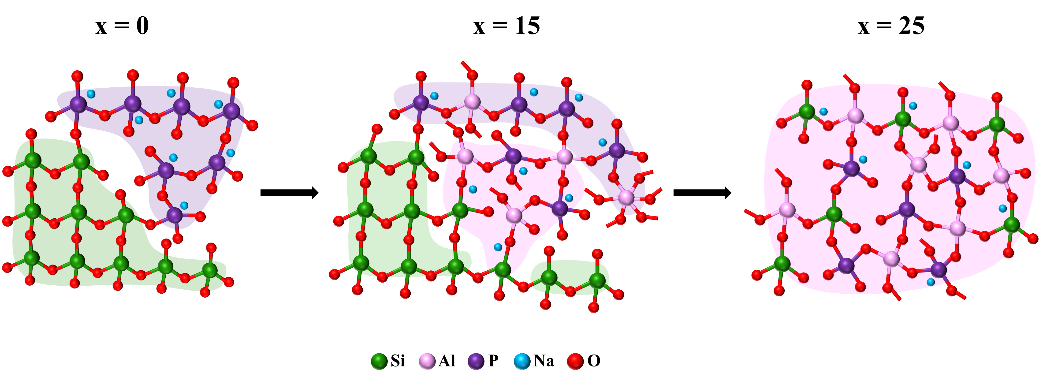
Figure 1. Schematic diagram of the structural evolution of Al2O3−NaPO3−SiO2 glasses.
Original link:http://pubs.acs.org/doi/abs/10.1021/acs.jpcc.5c0735